
A punching bag is the hardest-working piece of kit in any fight gym. Choose the right punching bag and it takes thousands of rounds. Choose wrong and it swings too much, splits at the seams, or simply doesn't suit the training you do.
How to choose a punching bag: the main types
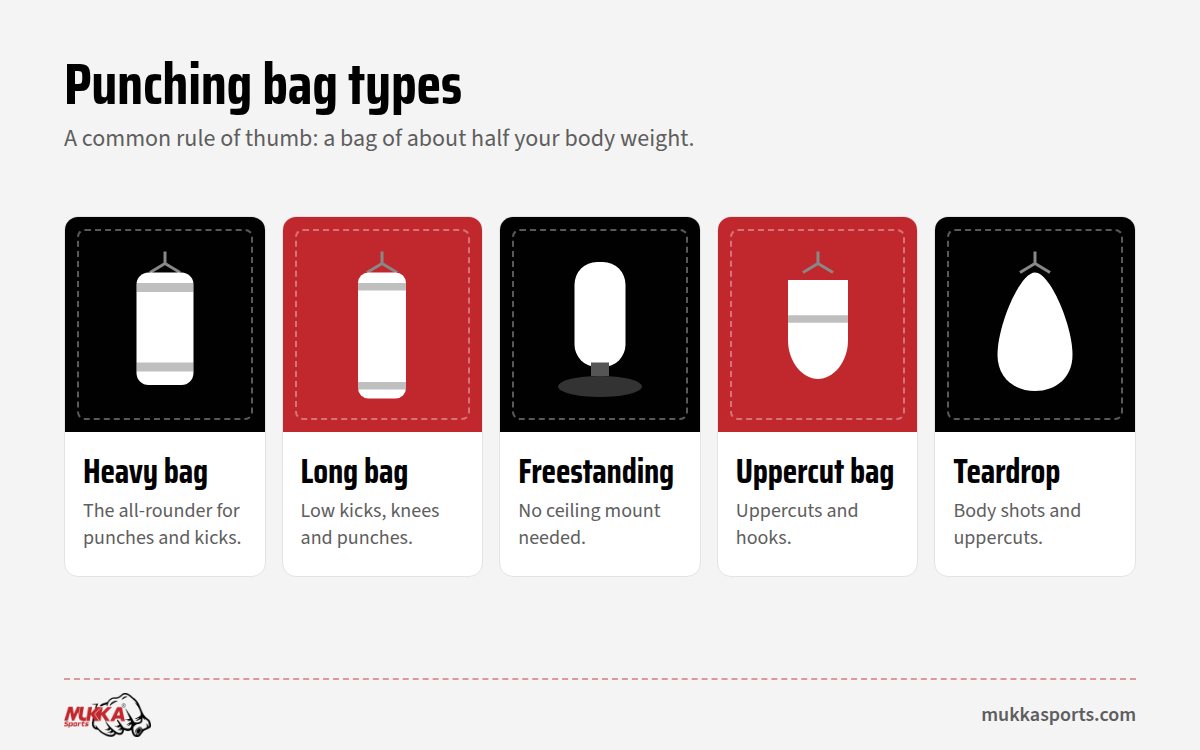
| Bag | Best for | Notes |
|---|---|---|
| Heavy bag | Power punches and kicks | The all-rounder, hangs from a ceiling mount or stand |
| Long or Muay Thai bag | Low kicks, knees and punches | Reaches down to leg height |
| Freestanding bag | Homes and rented spaces | Weighted base, no ceiling mount needed |
| Uppercut or angle bag | Uppercuts and hooks | Shaped to take punches from below and the side |
| Teardrop bag | Body shots and uppercuts | Wide at the bottom, narrow at the top |
How to choose a punching bag weight
A common rule of thumb is a bag of about half your body weight. Lighter bags swing more, which is good for speed and footwork. Heavier bags stay put, which suits power training. For a gym, a mix of weights lets every member train well.
Kicking? Choose a longer, heavier bag. Kicks move a bag much more than punches do.
Filled or unfilled?
- Filled bags arrive ready to hang with an even, tested fill. Simple, but heavier to ship.
- Unfilled bags are lighter to ship. You fill them with fabric scraps or a filling kit, and can adjust the firmness.
Hanging your bag safely
- Use a proper mount: a ceiling joist, a beam or a heavy-duty wall bracket, never a plasterboard ceiling alone.
- Leave space: enough room to move all the way around the bag.
- Hang at the right height: the top of the bag at about head height for boxing.
- Check chains and swivels regularly, especially in a busy gym.
Quality checks when you choose a punching bag
- Stitching: double or reinforced stitching at the top and bottom, where bags fail first.
- Straps and D-rings: strong straps and solid rings that won't pull out.
- Outer material: leather for the longest life, synthetic leather for value.
- Inner lining: a liner keeps the fill even and prevents hard spots.
Common mistakes to avoid
- Buying too light: a light bag swings wildly with every punch, so you spend the session chasing it.
- Weak mounting: a swinging bag puts heavy, repeated force on the ceiling. Use a proper joist or beam mount.
- No gloves on the bag: always wear bag gloves or boxing gloves with hand wraps.
- Uneven filling: settled fill creates a hard bottom and a soft top. Rotate and top up unfilled bags.
Mukka Sports makes punching bags, speed balls and training equipment in Sialkot, Pakistan, filled or unfilled, in your colours and with your gym's logo. Browse our fight gear or ask for a quote.
Frequently asked questions
What size punching bag is best for beginners?
A standard heavy bag of medium weight suits most beginners. A common rule of thumb is about half your body weight.
Can I hang a punching bag from any ceiling?
No. Use a ceiling joist, beam or a heavy-duty bracket. Plasterboard alone will not hold a swinging bag safely.
Is a filled or unfilled bag better?
Filled bags are ready to use. Unfilled bags cost less to ship and let you choose the firmness. Both work well when filled evenly.
How high should I hang a punching bag?
For boxing, hang it so the top of the bag is at about head height. For kicking, a longer bag that reaches down to leg height works best.
Can you put our gym logo on punching bags?
Yes. Bags can be made in your colours with your logo printed or embroidered.
Bags that take every round
Ready-stock bags or custom bags in your colours with your logo.